The birth of LEAF
The birth of LEAF was not linear.
It emerged during a moment in which we were questioning our own way of designing, wondering whether rationality had slowly become a comfort zone and whether, in pursuing technical correctness, we were losing the tension that makes an object truly necessary. We had developed products that were resolved, coherent, industrially sound, and yet increasingly quiet. They worked. They did not challenge anything.
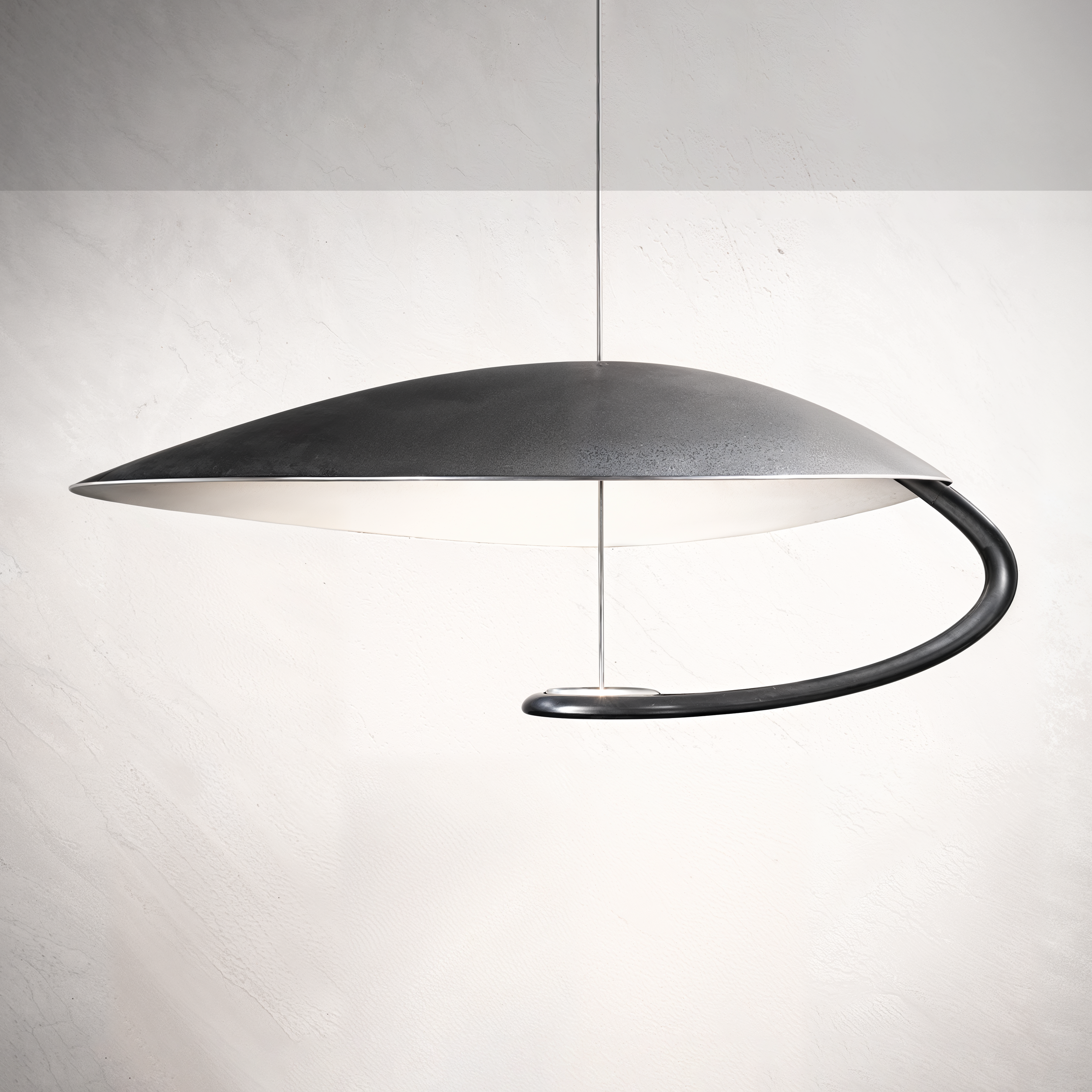
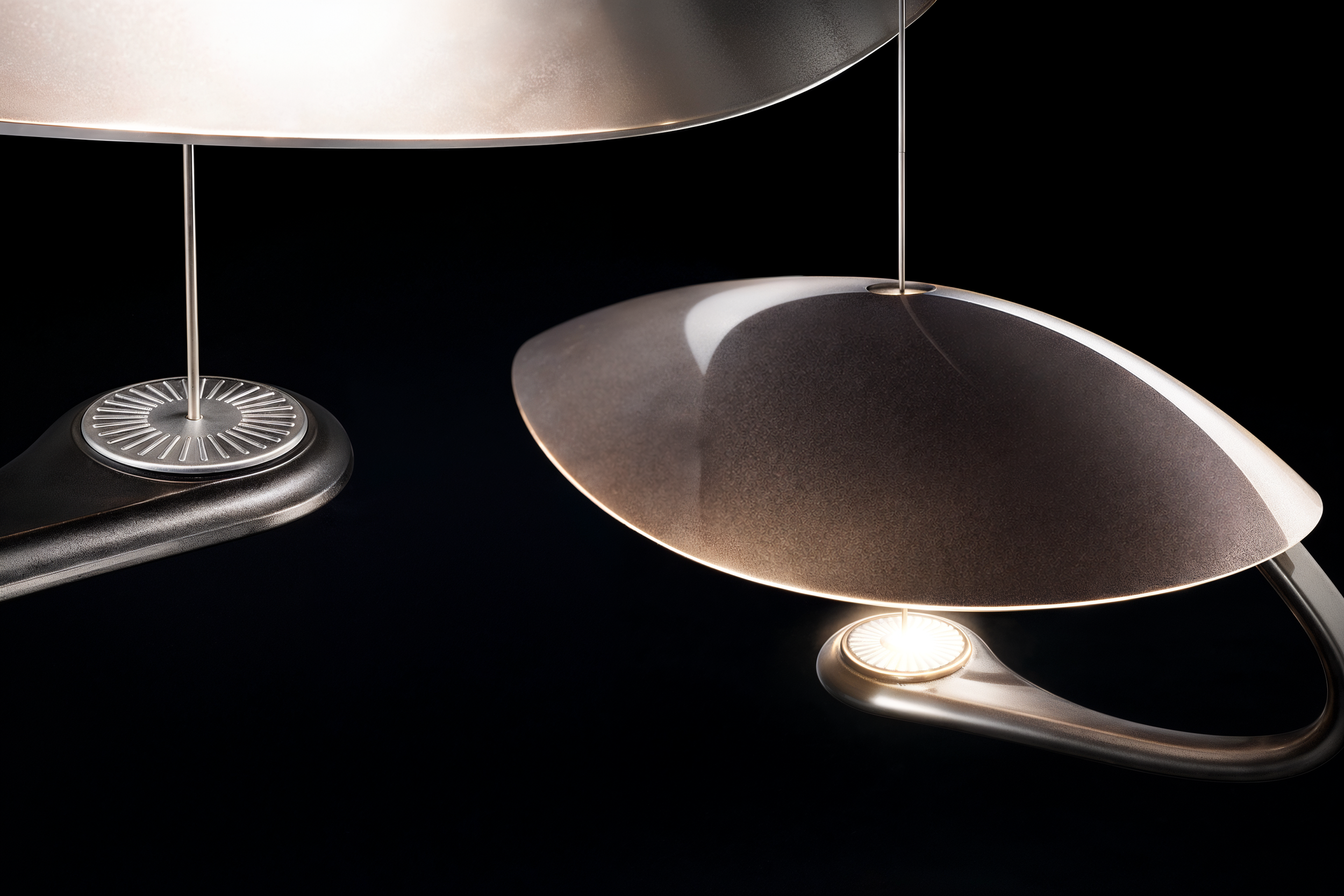
When we began working on this lamp, the starting point was rigorous: a light source and a diffuser. An elementary scheme. The lower stem was born from that logic, as an unavoidable technical element, a structure meant to contain the light, integrate it, support it. There was no expressive ambition in that gesture, no attempt to create character. Only function.
And yet, the more logical the system became, the more we felt something was missing.
It would have been simple to suspend the lamp at its geometric center, to align everything, to distribute the mass predictably. That solution would have been reassuring, structurally efficient, visually calm. But precisely for that reason, we chose not to follow it.
We decided to suspend the entire system from a single point, not located in the most canonical position.
That decision introduced a fracture.
A single suspension point means that balance is no longer guaranteed by symmetry; it must be constructed. It means gravity becomes part of the conversation rather than a force to be neutralized. The stem remained rational, direct, almost severe in its functional clarity. The leaf, initially conceived simply as a diffuser, began to shift within the system as the only element with real dimensional freedom.
Its size could expand or contract, and every adjustment altered the whole.
When enlarged, the system seemed on the verge of instability; when reduced, it returned to a discipline that felt overly controlled. Rational structure demanded order; intuition demanded deviation. What we were facing was no longer a formal decision, but a negotiation between two forces.
The solution was not a victory of one over the other.
It emerged when we stopped treating engineering and creativity as opposing domains and began allowing proportion to mediate between them. The stem was not a constraint to overcome; the leaf was not a gesture to justify. They were two energies that had to find a shared equilibrium.
LEAF reached its final configuration at the moment when real weight and perceived weight stopped contradicting each other. Suspended from a single point, slightly off-axis, yet perfectly horizontal, the object appears unstable while remaining precisely calibrated.
Looking at it now, we see not a decorative statement, but the trace of that internal tension. The stem embodies structural discipline; the leaf embodies controlled freedom. Neither dominates. Each exists because of the other.
Perhaps every meaningful project begins in this way, through an internal friction that cannot be avoided. Rationality constructs the system; creativity destabilizes it; and only when both accept coexistence does the object achieve balance.
LEAF is not a celebration of order, nor an expression of chaos. It is the moment in which the two decide to sustain one another.